top of page

Praia da Ursa

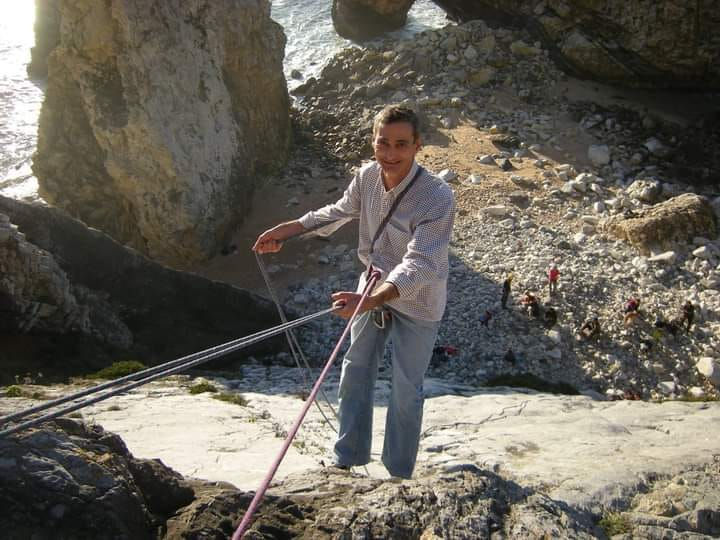
Facing west, this beach is divided by a creek called Ribeira da Ursa, with tall limestone cliffs flanking its northern side and pink and orange granite walls to the south, creating a stunning contrast in the landscape. Along the seashore, several boulders can be found—some climbable at low tide—but most climbing takes place on the cliff walls, especially within the gorge of the creek, which features a beautiful waterfall, and on the pink slab known as Rosa.

A small collection of trad routes scattered along the northern part of the beach offers additional opportunities for adventurous climbing.

Henrique Cabreira made the first topos of Praia da Ursa (probably in the late 80's) with descriptions of the routes and beautifull hand drawings of the lines. These pages have been passed on,hand to hand, from one climbing generation to the next ever since. 


Praia da Ursa

HOW TO GET THERE

Coming from Cascais or Sintra, follow the EN 247 road toward Cabo da Roca. Park near the lighthouse. From there, walk back along the road about 500 meters and take the second dirt road on your left. This path passes through a beautiful old pinewood, then follows the summit ridge before descending a valley that leads down to the beach. Alternatively, you can continue walking along the main asphalt road for about one kilometer until you reach the sign marked "Ursa." Turn left there and follow the dirt road to its end (approximately 800 meters), then descend the valley to the beach.

APPROACH

Parking and Access Park your car near the tourism office by the lighthouse at Cabo da Roca. You can also park near the sign that reads "Ursa," about one kilometer before the lighthouse, but this area has experienced some car break-ins. It is safer to leave your car at the lighthouse and walk back from there. All routes are accessible from the beach. Pay attention to the tides, as some sectors become inaccessible during high tide.

COMMENTS

Bolts condition All routes have been rebolted, except for sport routes 1 and 2 in Placa Rosa, where 304 stainless steel glue-in bolts remain in poor condition. Route height 10-75 m aprox. Restrictions Accordingly to Carta Desporto Natureza PNSC : Rosas:  January 1st to May 31th - a maximum of 6 climbers is allowed in this sector; June 1 to September 30 th - no climbing allowed in this sector, October 1th to December 31 th- a maximum of 16 climbers is allowed in this sector.  Gaivota, Cascata e Negras:  January 1st to July 14th - a maximum of 6 climbers is allowed in these sectors; July 15th to December 31th- a maximum of 16 climbers is allowed in these sectors.  Other comments Climbing timing and conditions During summer, the sun sets farther north, so in this season you can spend the day relaxing on the beach and start climbing after 4 pm until sunset. Watch the tides carefully, as high tide can cut off access from the gorge to the beach. For sport climbing at Cascata da Ursa Keep in mind that the gorge is very narrow and faces west, so it only receives sunlight in the late evening during summer months. For the routes at Placa Rosa Be cautious of bystanders on the beach due to the risk of falling rock. It is best to avoid climbing here if the beach is crowded. Sub-sector descriptions A / Cascata A small creek ends in this narrow gorge with a 15-meter waterfall dropping onto the beach sand. The side wall of this channel hosts about 15 quality sport routes developed by Nuno Pinheiro, "Guga" Ramos, Francisco Ataíde, Filipe Costa e Silva, and Carlos Simes. Routes vary from vertical to slightly overhanging, requiring stamina and technique. These climbs are ideal for late afternoons in summer, the only time sunlight reaches inside the gorge. B / Placa Rosa Placa Rosa ("the pink slab") sits in the center of the beach and is perfect for introducing climbers to trad climbing. On its colorful pink granite, you’ll find some of the older classic routes from the 1980s, as well as newer lines from the 1990s. Above and to the right of Placa Rosa is Placa Negra ("the black slab"), a dark-colored wall offering technical face climbs on bulletproof granite. While the original first ascensionists are uncertain, Henrique Cabreira was the main enthusiast in the 1980s, with Sérgio Bruno adding several lines in the 1990s. Both slabs remain popular, featuring slabs, cracks, dihedrals, roofs, and platforms, with some routes having two pitches. The rock is mostly solid, though some sections have loose patches. All anchors have been recently rebolted. C / Gaivota This big limestone boulder, named Gaivota ("seagull"), lies below the Ursa sea stack on the northern part of the beach. It contrasts with the granite boulders found on the southern side. D / Calhau dos Corvos Located on the south side of the beach, this area features a couple of granite boulders. The boulder closest to shore has a new lower-off station and is climbable only during low tide. The line follows a basalt strike on the east face, and anchors placed on the southern side allow for top-roping possibilities on the south face. E / Other lines At the far northern end of the beach, there are still a few additional lines to explore.
#
Sub Sector
Route Name
Grade
Quality
Style
Type
Rock Type
Opened by
Date
Bolt Conditions
Rebolted
1
Praia da Ursa Norte
Nas barbas de toda a gente
6a
2
Adventure
Single
Limestone
Paulo Roxo, Miguel Grillo
9/23/06
Unknown
No
2
Praia da Ursa Norte
Mentes retorcidas
V, 6a+, V+, V
2
Adventure
Multipitch
Limestone
Paulo Roxo, Miguel Grillo
9/23/06
Unknown
No
3
Praia da Ursa Norte
Deusa turquesa
6a, 6a+, IV
2
Adventure
Multipitch
Limestone
Paulo Roxo, Miguel Grillo
9/24/06
Unknown
No
4
Praia da Ursa Norte
Fomeca
7a (A1), V+, V
2
Adventure
Multipitch
Limestone
Paulo Roxo, Daniela Teixeira
8/27/06
Good
Yes (316L) 2025 RR
1
Placa Deitada
Top rope dos Pitons e Spits
III
1
Traditional
Single
Limestone
Rogério Morais
1990's
Good
Yes (Cosiroc) 2022 LF
2
Placa Deitada
Top rope dos Pitons e Spits
III
1
Traditional
Single
Limestone
Rogério Morais
1990's
Good
Yes (Cosiroc) 2022 LF
3
Placa Deitada
Subida e destrepe sem top
V
1
Traditional
Single
Limestone
Rogério Morais
1990's
No bolts
No
1
Gaivota
Placa da face sul
III ou IV
1
Traditional
Single
Limestone
?
?
Unknown
No
2
Gaivota
Diedro da face este
IV+
2
Adventure
Single
Limestone
?
?
Unknown
No
3
Gaivota
Fissura da face norte
V
2
Traditional
Single
Limestone
?
?
Unknown
No
Page 1 of 5

Legends

bottom of page